
Childress Police Custody Role
The Childress Police Department is a municipal law-enforcement agency. It can arrest a person, create an incident or offense report, and transfer that person to a detention facility. The official source sweep did not establish a separately operated, long-term municipal jail or city release archive. That finding changes the lookup: ask where the person was booked, then use that facility's record.
An arrest report and a release log serve different roles. The police report may establish the event, alleged charge, incident number, and handoff. The receiving jail's movement record shows when custody there began and ended. A court document may explain bond, dismissal, judgment, sentence, or another order. None should be made to answer a question outside its scope.
| Question | Likely record holder |
|---|---|
| Who made the arrest? | Childress Police Department |
| Where was the person booked? | Police handoff or incident record |
| When did jail custody end? | Receiving jail |
| Why did the case status change? | Relevant court |
Trace Childress Police Release
Call the Police Department at (940) 937-2546 with the person's full name, date of birth if known, approximate arrest date, location, and incident number. Ask for the receiving facility and any public case identifier. Keep the answer precise. A statement that police no longer hold the person does not prove community release if a jail or another agency accepted custody.
If Childress County Jail received the person, use Childress County IVSS for a current named status check. Then call the sheriff and request the movement entry. If police identify another county, TDCJ, USMS, or ICE as the next custodian, switch to that agency's system. The Childress County release search maps those distinct channels.
- Collect the full name, aliases, and approximate arrest time.
- Ask police for the incident number and receiving facility.
- Search or contact that facility with its own identifier.
- Ask whether custody ended by community release or transfer.
- Match the jail movement to the relevant court cause.
Childress Police Contact Record
The official Police Department contact number is (940) 937-2546. Use that office to identify the arrest report, incident number, and initial receiving facility. Do not ask police to certify a later jail-door time when another agency controlled the detention. Direct a release-record request to the jail or state, federal, or immigration custodian that actually recorded the movement.
Prepare a narrow request. Give the person's full name, aliases, date of birth if known, arrest date range, incident location, and case number. Ask for the public incident report and documentation identifying the facility that accepted custody. Redactions or withholding may apply under Texas law, especially when an investigation is active or protected information is involved. The custodian must make that legal determination.
- Arresting agency
- The office that made or documented the arrest.
- Receiving facility
- The jail or prison that accepted physical custody.
- Release authority
- The bond, order, sentence event, or other basis entered for release.
- Detainer
- Authority that may keep custody active for a different agency.
Childress Police Source Screen
The official city Police Department page is the source for municipal contact and agency identity.
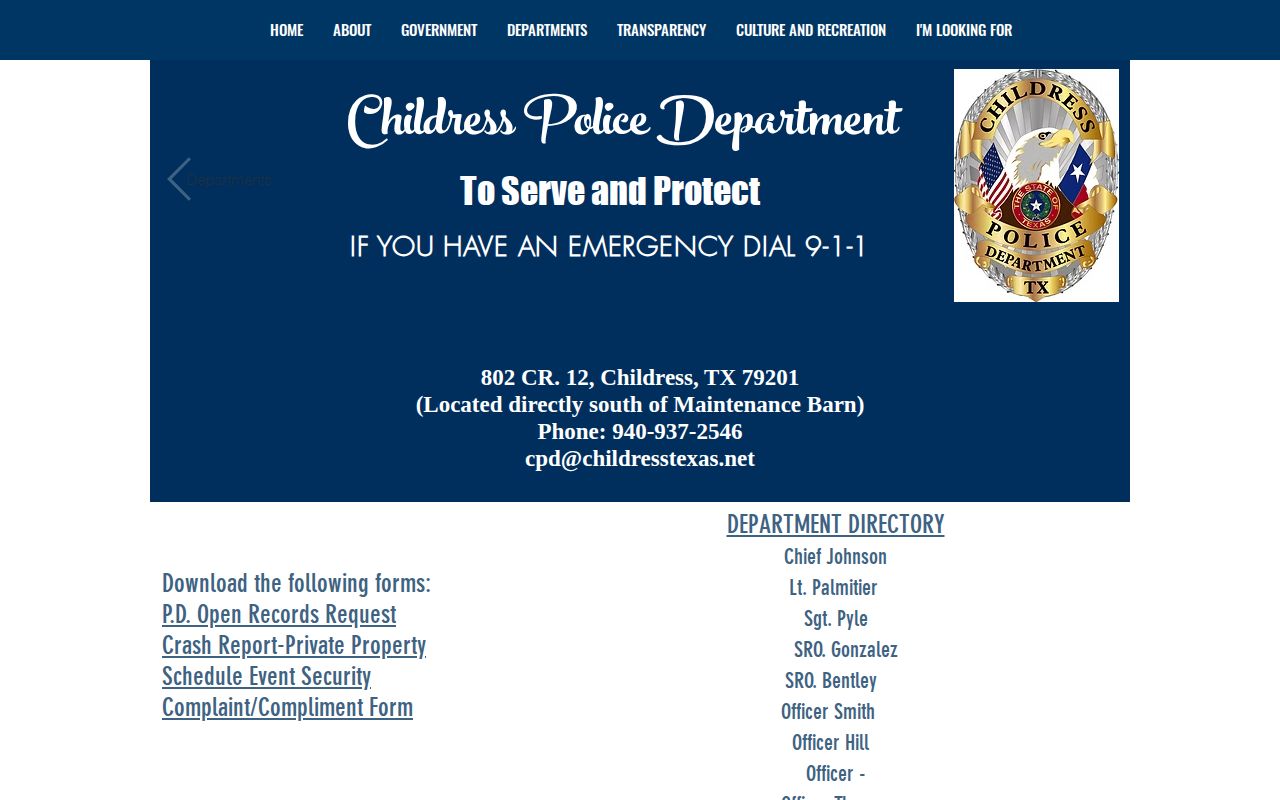
The screen should be used as an agency-routing source, not as proof that a named person was released. Once the receiving facility is known, its live status and written custody log control the later release question.
Note: Record the date of the police inquiry because contact details and agency procedures can change.
Childress Jail Release Handoff
Childress County Jail is the first likely local custody path after a city arrest, but it should be confirmed rather than assumed. The Sheriff's Office operates the jail. Its IVSS route accepts a full name or jail-assigned identification number for a custody check. A no-match may reflect spelling, timing, transfer, or system scope. Call (940) 937-2535 and ask about the named booking.
For a written sheriff request, ask for the booking sheet, custody or release log, actual release date and time, release type or authority, and destination. Send it to sheriff@childresstx.us or 1005 Avenue F NW, Childress, TX 79201. Ask for electronic copies and a cost estimate. The Childress County Jail release record gives the full local workflow.
Possible outcomes include bond, personal bond, dismissal, time served, sentence completion, court order, and transfer. Bond does not end the case. A dismissal does not establish the exact jail release time. Transfer to TDCJ, another county, USMS, or ICE ends Childress jail custody but is not community release.
Childress Release Court Match
The court record supplies the durable legal layer after a short-lived custody display changes. Obtain the cause number from police or the receiving jail. Then locate the filed matter and request the bond order, dismissal, judgment, sentence, jail-credit record, or revocation that may explain the custody change. Compare its date with the jail's actual movement time.
Childress County's online court index is a convenience source. It is not certified, may omit or redact material, and can lack images. Name variants may help locate a cause, but the cause number is the safer request key. Felony records generally route through the 100th District Court, appropriate misdemeanor matters through county court, and citations may be filed in Justice Court. Verify the actual filing.
A two-source packet is stronger than either record alone. Pair the receiving jail's release entry with the signed court order. If the jail record says transfer, pair it with the new custodian's result instead of describing a release to the community.
Childress Release System Boundaries
Roach Unit is in Childress County, but it is a TDCJ state prison. If the police-to-jail trail later ends in TDCJ intake, use the TDCJ number or SID number in the statewide offender search. A county booking number is not a TDCJ identifier. The public state search covers current prisoners only and is at least 24 hours old, so central TDCJ records are needed for a former prisoner.
Federal and immigration routes also require care. BOP covers federal prisoners. USMS can explain federal prisoner custody, while ICE's locator concerns current immigration detention and is not a complete historical archive. No official source found a federal prison, dedicated ICE detention center, or distinct municipal jail in Childress County. Still, a transfer to one of those systems may occur.
| Next custodian | Use this path |
|---|---|
| Childress County Jail | County IVSS and sheriff movement record |
| TDCJ | State offender search and central records |
| Federal custody | BOP or USMS record |
| Immigration custody | ICE locator and agency contact |
Childress Release Identifier Checks
Use the identifier created by each system. The police incident number helps retrieve the arrest report. A county booking number helps the sheriff locate a jail movement. TDCJ uses its own number or SID, BOP uses federal identifiers, and ICE may use an A-number with country of birth. Entering one agency's number in another agency's field can yield a misleading no-match.
When sources conflict, retain the exact labels and check times. Ask the last verified custodian whether the person left for the community or another agency. Then request the underlying handoff or movement entry. A no-result, changed roster, or old arrest report cannot answer that question alone.
Childress Police Proof Chain
The police report and jail movement serve different roles. A CPD report can establish the arrest, incident number, alleged offense, and first handoff. It ordinarily cannot establish a later jail release timestamp if another agency held the person. Ask CPD which jail received the arrestee, then use that facility's booking number and records office. Match the result to the proper court cause before drawing a conclusion.
For a county jail handoff, request the sheriff's booking sheet and custody or release entry. Ask whether the booking ended by community release, transfer, or another custody-ending event. If the destination was TDCJ, another county, USMS, or ICE, continue with that agency. A receiving-agency name is more useful than a vague “out” label because it identifies the next authoritative source.
Keep dates in order: police contact, jail booking, court order, actual release or transfer, and receiving-agency intake. They may occur on different days. A court order can explain the legal basis but may precede physical processing. The last custodian's movement record is the best source for the actual handoff time.
If a field is wrong, write to the office that created it. Cite the incident, booking, or cause number and attach the record supporting the correction. Changes do not always flow at once from police to jail, court, IVSS, or another agency, so verify each system separately.
Note: An arrest report begins the trail; it does not replace the receiving jail's release or transfer record.
Public Record Search
Sponsored Results