
Roach Unit Release Classification
TDCJ identifies T. L. Roach Unit as a male Correctional Institutions Division prison. The unit houses state prisoners at custody levels G1, G2, and G4. It is not operated by the Childress County Sheriff. TDCJ controls placement, sentence calculations, transfers, parole processing, mandatory supervision, and discharge records for people held there.
A unit departure alone proves very little. TDCJ may move a prisoner from Roach to another unit without ending state custody. Parole and mandatory supervision mean physical release from prison under conditions and TDCJ supervision. Discharge means the sentence or supervision relationship shown by TDCJ has ended. Those terms should not be merged.
| Roach departure | Meaning | Best confirmation |
|---|---|---|
| Unit transfer | Still in TDCJ custody | Current TDCJ location |
| Parole | Community release under supervision | TDCJ history and Parole Division |
| Mandatory supervision | Conditional community release | TDCJ and BPP records |
| Discharge | Completion reflected by TDCJ | Incarceration history and judgment |
Confirm Roach Unit Release
Begin with the TDCJ online inmate search. Use a TDCJ number or State Identification number when available. Those identifiers reduce name collisions. The form also accepts last name, first name, gender, and race; a name search requires a last name and at least a first initial, and last-name matching is exact. Validate the result with date of birth, offense, county, and number.
The public search covers only people currently incarcerated in a TDCJ facility. It updates on working days and is at least 24 hours old. Therefore, a former Roach prisoner may vanish from it. That absence cannot establish release. Contact TDCJ inmate information and Classification and Records for incarceration history, actual release or discharge status, and date. If the record indicates parole, verify supervision through the Parole Division and, when relevant, the Texas Board of Pardons and Paroles.
- Search by TDCJ or SID number when possible.
- Record the location, status, and update warning.
- Keep projected release and parole eligibility separate.
- Request history when the current search returns no former prisoner.
- Pair the result with parole or sentencing-court records.
Roach Unit Dates Explained
A projected release date is TDCJ's current administrative forecast. It is not a past release date. A parole eligibility date marks a possible review point and does not promise approval. A favorable board vote also may require a program, a future month, or other conditions before physical release. Maximum expiration is a sentence-calculation field, while actual discharge is a historical event.
Dates can change after a disciplinary action, lost or restored good-conduct credit, corrected jail credit, a new sentence, a detainer, or a parole decision. Texas good-conduct time is a privilege tied to classification and may affect eligibility, but it does not simply reduce the sentence imposed. There is no general Texas rule that everyone must serve 85 percent. The relevant offense, offense date, sentence, deadly-weapon finding, and statutory category all matter.
- Projected release
- A current TDCJ forecast that may move.
- Parole eligibility
- The point when review may become legally possible.
- Mandatory supervision
- Conditional release governed by sentence rules and, in some cases, board approval.
- Discharge
- Completion of the sentence relationship reflected in the state record.
Roach Unit Records Contact
The unit is at 15845 FM 164, Childress, TX 79201, two miles southwest of Highway 287. Its published telephone is (940) 937-6364. Use the unit for current facility operations and routing questions. Central TDCJ inmate information is the stronger source for official state status, incarceration history, sentence fields, and release or discharge confirmation.
Before calling, collect the full name, aliases, date of birth, TDCJ number, SID number, offense, sentencing county, and approximate dates. Ask one clear question at a time: whether the person transferred, entered supervised release, or discharged; what actual date applies; and which record can document it. If the answer matters, follow the call with a written public-information request and retain the agency response.
The sentencing court adds the legal layer. A strong release packet pairs TDCJ incarceration history and actual status with a parole decision or judgment. The court order explains the sentence. TDCJ explains how it administered custody and when prison custody ended.
Why Roach Release Records Differ
Roach Unit opened in August 1991 and has a listed capacity of 1,384. Its location makes Childress County unusual: the county contains a prominent state prison as well as a county jail. The two systems must stay separate in every search. The county's IVSS route concerns local jail custody. The statewide TDCJ system concerns Roach and other state units.
The official Roach Unit directory shows its identity, operator, and location.
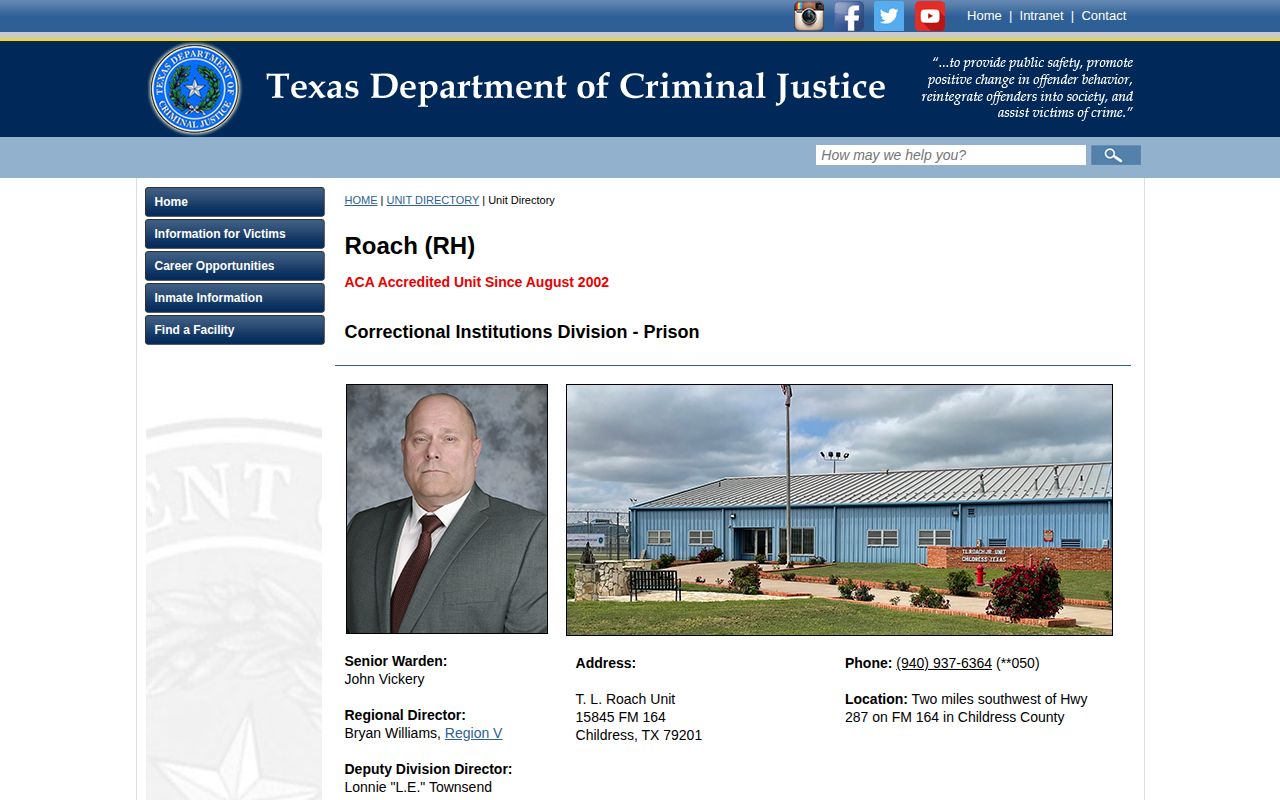
The unit also lists CHANGES, pre-release, and reentry planning among its programs. Those services are for eligible state prisoners under TDCJ control. They do not describe services for every person leaving Childress County Jail, and availability should be confirmed through TDCJ.
Roach Release Versus Transfer
Classification protects against the most common false conclusion. If a current result changes from Roach to another TDCJ unit, the event is a transfer. If the person disappears, the search's current-only limit requires a records inquiry. If TDCJ confirms parole or mandatory supervision, prison custody ended but supervision continues. Only an actual discharge record supports completion of the state relationship reported there.
County and federal systems also have limits. A county booking number does not belong in a TDCJ identifier field. BOP covers federal prison, while ICE's locator concerns current immigration detention and is not a historical release archive. The Childress County Jail release route applies only when the sheriff was the last custodian.
Note: Preserve the exact TDCJ label and its information date instead of translating a status into a broader claim.
Roach Parole Release Proof
For a parole result, the Texas Board of Pardons and Paroles decision and TDCJ physical-release status answer different questions. Texas panels review files rather than holding a routine public formal hearing for each case. A favorable vote can set a future date or require a program. Confirm the actual release afterward through TDCJ, then use the assigned parole office for current supervision questions.
For a discharge inquiry, request incarceration history with the TDCJ and SID numbers, sentence cause, and date range. Compare it with the judgment and any corrected jail credit. A court record may not reflect later administrative calculations at once, while the current offender search excludes former prisoners. Keeping both sources makes the difference between a forecast, a release to supervision, and final discharge clear.
Correcting Roach Release Records
A public result should be copied with its agency name, update date, and exact field label. Keep projected release, parole eligibility, scheduled mandatory supervision, maximum expiration, actual release, and discharge as distinct dates. If a value appears wrong, identify the field rather than saying the whole record is inaccurate. Provide the TDCJ number, SID, sentencing cause, judgment, and any amended order to the office that owns the calculation.
TDCJ Classification and Records is the proper route for incarceration history and central release or sentence information. The Roach Unit can answer facility questions, but it should not be asked to reinterpret a central parole calculation. A parole decision belongs with the Board and Parole Division. A judgment or corrected court order belongs with the filing court. Updating one source may not immediately update another, so record the date of each inquiry.
A reliable Roach packet uses at least two sources. For parole, keep the TDCJ actual release status with the board decision or Parole Division record. For discharge, pair incarceration history with the judgment. For a unit transfer, keep both the old and new TDCJ locations. This prevents a move between prisons from being misreported as release into Childress County.
Note: The current TDCJ locator is a custody snapshot, while release and discharge proof often requires central historical records.
Public Record Search
Sponsored Results