
Childress County IVSS Coverage
Texas now uses the Integrated Victim Services System, or IVSS, as its official victim-notification service. Childress County expressly participates through the county IVSS portal. The local sheriff page says a person can search by full name or jail-assigned identification number and obtain free telephone or email notices. VINELink remains a national access route, but local instructions should begin with Texas IVSS.
IVSS can report a custody status or change for a participating county booking. It does not turn a notice into a certified release record. When the result changes, ask Childress County Jail whether custody ended through community release or transfer and obtain the custody-log entry if the distinction matters.
Search a Childress IVSS Record
Use the identifier that belongs to the county system. A TDCJ number, federal number, or court cause number should not be pasted into a jail-ID field and treated as a valid test.
- Open the Texas county IVSS portal.
- Enter the person's full name or jail-assigned ID as the interface permits.
- Compare any match with known identity and agency details.
- Open the matching record and transcribe its exact status label.
- Save the date and time checked, then confirm an important change with the custodian.
Try documented spelling variants when no result appears. A blank result can reflect spelling, timing, transfer, suppression rules, or use of the wrong agency. It never proves release.
Childress IVSS Release Fields
The live interface controls which fields are visible. Record only what it actually shows. The county publicly confirms name and jail-ID search keys, but other result details should not be promised without seeing them.
| Item | How to use it |
|---|---|
| Name or jail ID | Matches the notification record to the county booking. |
| Custody agency | Identifies which office should confirm the event. |
| Exact status label | Preserves the system's wording without guessing. |
| Status date or update time | Shows how current the displayed event may be. |
| Notification options | Shows which current contact methods the portal offers. |
IVSS may tell a subscriber that custody changed. The sheriff's release entry supplies the actual time, type, authority, and destination. Pair that entry with the related bond, dismissal, judgment, or sentence order when stronger proof is needed.
Register Childress Release Notifications
Registration should follow the current IVSS prompts. Texas migrated from legacy VINE, so old instructions about a four-digit VINE PIN should not be presented as the current Childress procedure. Use only the confirmation steps shown by today's portal.
- Open the correct person's IVSS record.
- Select the available notification or registration control.
- Choose a supported telephone or email method.
- Enter and verify the contact detail requested by IVSS.
- Complete the portal's current confirmation step and retain the registration record.
Keep contact details current. A notice can be delayed, and delivery failure does not establish that custody stayed the same. Direct confirmation remains the safest path before travel or a time-sensitive court process.
Childress VINELink Release Limits
County IVSS, state-prison records, federal custody, immigration detention, and registry duties are separate channels. Use Childress IVSS for a county booking. Use TDCJ inmate information for a state prisoner, including someone housed at the T. L. Roach Unit. The public TDCJ search is current-custody-only and at least 24 hours old, so a former prisoner requires a records or parole inquiry.
The BOP locator covers federal prison, while the ICE locator covers current immigration detention within its limits. The Texas sex-offender registry covers only people with a registration duty and is not a general release locator.
Texas IVSS Replaced Legacy VINE
Texas moved from legacy VINE to IVSS on September 1, 2025. Existing registrations were transferred as part of the statewide change, and the Attorney General describes IVSS as a Sylogist implementation funded through victim-services work. This migration is the distinctive Childress notification fact because it changes the portal and registration workflow.
The county's participation is not inferred from a national directory. The Childress County Sheriff page links directly to IVSS. Texas also operates a separate state-prison IVSS route. Users should confirm which custodian holds the person before selecting one.
Confirm a Childress Release
For a county booking, call (940) 937-2535 and ask one question at a time: Did custody end through community release or transfer? What was the actual date and time? Which agency received custody? What existing record confirms it? Follow a vital answer with a written request to sheriff@childresstx.us.
For a state case, distinguish parole, mandatory supervision, discharge, and transfer. Parole and mandatory supervision mean prison custody ended while supervision continues. Discharge means the TDCJ sentence or supervision relationship shown by the agency ended. A projected release date or parole eligibility date does not prove an actual departure.
View Childress Notification Portals
The Texas county IVSS portal shown below is the primary local route:
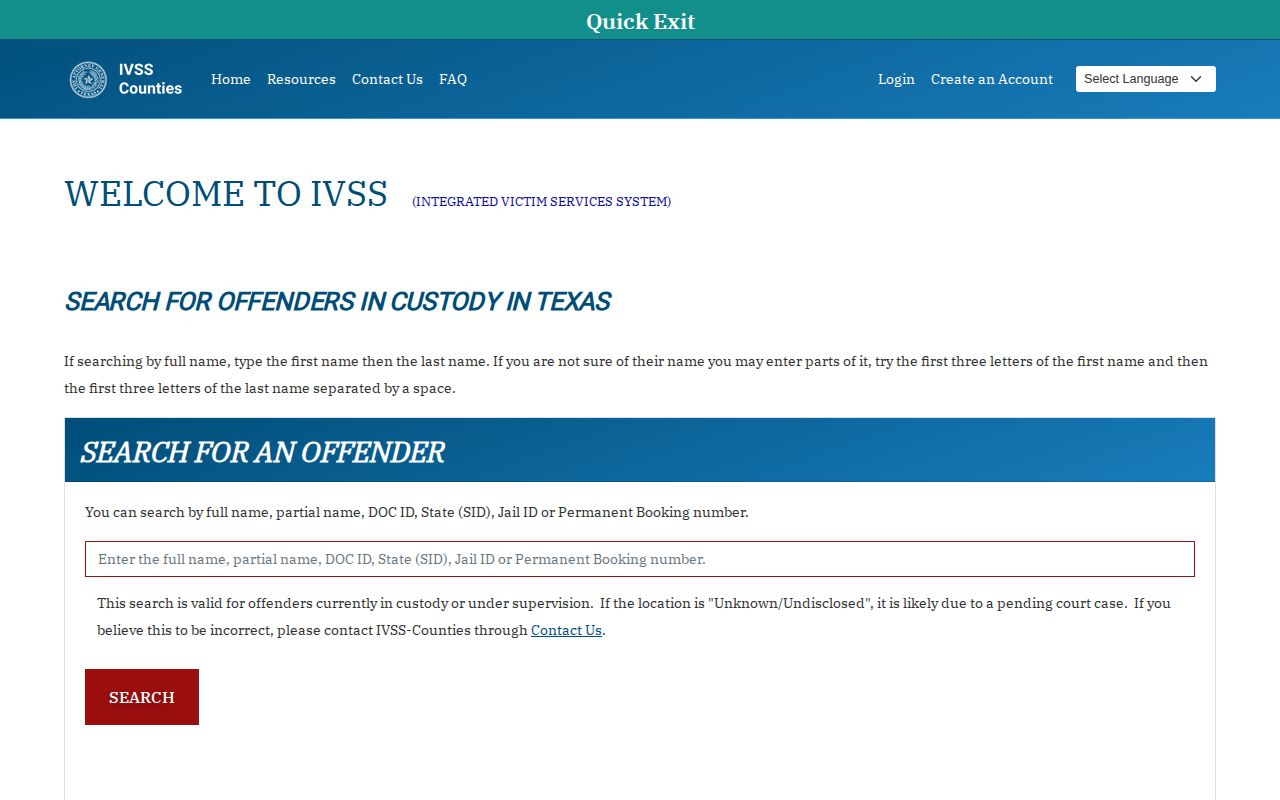
The capture helps identify the official county search environment. Result fields must still be read from the live record.
For a national fallback, open VINELink and identify the correct participating agency:
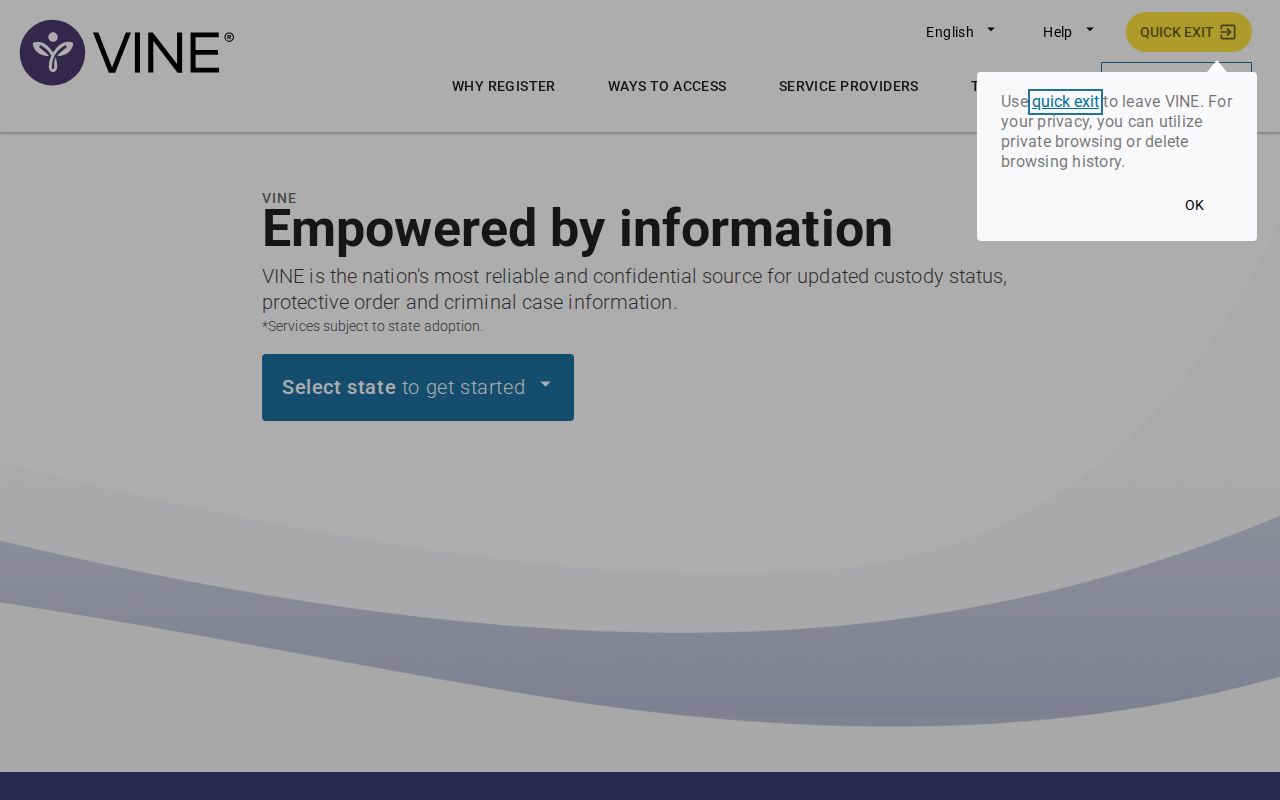
The national screen is an access route, not evidence that every agency or custody type is covered.
Resolve Childress IVSS No Results
A no-result screen calls for a scope check, not a conclusion. Confirm spelling, aliases, birth details, and the jail-assigned ID. Make sure the person was booked into Childress County Jail. An arrest by Childress Police Department may lead to another jail, and the arresting agency may not hold the later release timestamp.
Next, check whether custody moved. A booking can end in transfer to TDCJ, another county, the U.S. Marshals Service, or immigration authorities. Ask the sheriff for the receiving-agency category. If TDCJ received the person, use the TDCJ number or SID where possible. If federal custody is named, use BOP. For immigration transfer, use ICE within its current-coverage limits.
Finally, use the court cause. The Childress online index is a guide and can be incomplete, so obtain the signed order from the clerk when the result matters. A court order may explain bond, dismissal, sentence, or revocation. It does not replace the jail's physical release time.
Preserve Childress Notification Evidence
Record the official page title, domain, visible update notice, search fields, exact result label, and time checked. Retain only details needed to identify the record. A screenshot of a portal or notice is corroboration, not a certified custody history. The originating agency remains the custodian.
Keep each date in its proper category. Booking date, court-order date, actual jail release time, projected release date, parole eligibility date, and discharge date answer different questions. A projected date can move. Eligibility marks a review point. Actual release is historical, while discharge reflects the end of the sentence or supervision relationship recorded by TDCJ.
When a correction is needed, identify the disputed field and send the supporting order to the proper custodian. Fixing one system may not update IVSS, court indexes, and other notices at once.
Childress Release Proof Pairs
Two-source confirmation limits the risk of reading too much into one alert. For county community release, pair the sheriff entry with the bond, dismissal, judgment, or sentence order. For county-to-TDCJ transfer, pair the sheriff destination with TDCJ intake. For TDCJ parole, pair actual release information with Parole Division or board information.
A federal result is stronger when paired with the federal docket. An immigration transfer is stronger when the sheriff destination is paired with ICE information. These combinations organize evidence, but they do not make an uncertified copy legally certified.
Note: Ask one clear question per call, record the office and time, then follow important answers with a written request.
Call Childress Custody Offices
Before calling, assemble the full name, aliases, date of birth, jail ID, booking or cause number, and approximate dates. Ask whether Childress custody ended through community release or transfer, the actual time, the receiving agency, and which record confirms the answer.
Record the office, time, and staff title without publishing personal staff information. A call can clarify an alert, but a written entry is easier to reconcile with a court order. Send a follow-up request when the status affects travel, a filing, or another time-sensitive step.
Separate Childress Status Labels
Transcribe the exact label and agency. “In custody” is custodian-specific. “Released,” “not in custody,” parole, mandatory supervision, and discharge are not interchangeable. IVSS may show a custody change without giving the release type or destination. The sheriff entry must supply that missing context.
TDCJ's public search excludes former prisoners. A disappearance after a known state-prison stay does not confirm discharge. Contact TDCJ Classification and Records for incarceration history, then use parole information or the sentencing court where applicable. TDCJ search fields also belong only to TDCJ. A county booking number should not be tested as a TDCJ number and read as a meaningful no-result.
The same rule applies nationally. BOP identifiers belong to the federal locator, and ICE's A-number route requires its own inputs. Match each identifier to its system before interpreting any status.
Note: A notification supports follow-up, but the last custodian's movement record remains the source for the actual release event.