
Childress Projected Versus Actual Release
A projected date is TDCJ’s current administrative estimate under the sentence and credits that apply. It is not a release order. Parole eligibility is different: it marks when review may become possible, not a promise that the board will approve release. The maximum-expiration date reflects sentence calculation, while discharge is historical proof that the sentence or supervision relationship ended.
At Childress County Jail, a pretrial detainee has no ordinary sentence-based release date. Custody may end after bond, dismissal, a court order, or transfer. A signed order may arrive before physical processing is complete. The sheriff’s movement record supplies the actual time and destination.
A court’s sentence date is not necessarily the date custody ends. Jail credit may refer to earlier time, while TDCJ later applies the judgment under state rules. Likewise, a board decision can occur before release arrangements are complete. Record the label printed by each office instead of shortening several dates into one “release date.”
Find a Childress Inmate Release Date
The route depends on custody. T. L. Roach Unit is a state prison in Childress County, so TDCJ owns its date fields. The sheriff owns the local jail movement record. The police department may identify the receiving jail but normally does not own the later timestamp.
- Identify the last custodian and collect a full name plus TDCJ, SID, booking, birth-date, or cause information.
- For a current state prisoner, use the TDCJ inmate search. Read projected release and parole eligibility as separate fields.
- For a county-jail case, ask whether the court order arrived, whether another hold remains, and which record carries the release date.
- Obtain the judgment, sentence, bond, dismissal, or revocation order. It explains legal authority but may not show the jail-door time.
- After release, request the sheriff movement entry or TDCJ incarceration history. A missing current-search result is inconclusive.
The full custody-classification path is on the Childress County released inmates home page.
Childress Texas Credits Shape Release Dates
Texas has no sound universal rule that each prisoner serves 85 percent of a sentence. Eligibility and calculations depend on offense, offense date, sentence, credits, and statute. Under Government Code Chapter 498, good conduct time is a privilege used in TDCJ calculations. It is not a court-ordered sentence reduction, and it may be lost for disciplinary reasons.
Parole eligibility is governed chiefly by Government Code Chapter 508. Section 508.145 contains offense-specific formulas and exclusions. Mandatory supervision under Sections 508.147 and 508.149 is also status dependent. TDCJ’s own projected field is safer than a home calculation based on sentence length.
County jail credits are separate. No Childress-specific good-time formula was published. Request the judgment, jail-credit recital, custody ledger, and jail calculation instead of importing a TDCJ formula.
A projected date can also be limited by law even when time credits exist. Offense category and date determine which version of a statute applies. New sentences, corrected judgments, disciplinary events, and recalculated credits may change the display. Because those inputs are case specific, staff at TDCJ Classification and Records are better placed to explain the official field than the Roach Unit or a county clerk.
Mandatory supervision must not be described as automatic for every sentence. Statutory exclusions and review provisions matter. Parole also depends on a board process rather than the arrival of an eligibility date. A public date field should be copied exactly, with its agency and information date, so eligibility, projection, scheduled mandatory supervision, maximum expiration, and actual discharge do not collapse into one misleading answer.
Why Childress Release Dates Change
A forecast can move before release. The cause may sit in a sentence record, TDCJ calculation, parole process, or another agency hold. Ask the office that owns the changed field for its current record and information date.
| Factor | Effect | Source |
|---|---|---|
| Good-time award or loss | Changes the projection where applicable | TDCJ records |
| Detainer or warrant | May cause continued custody or transfer | Holding and receiving agencies |
| Corrected court order | Changes sentence terms or jail credit | Signed court record |
| Parole decision | Grant, denial, or review changes the path | BPP and Parole Division |
| New sentence | Another cause may keep custody in place | Court plus custodian |
| Update lag | Old data remains visible | Agency notice and staff |
A detainer is a notice from another authority concerning custody. It may mean the person leaves Childress but enters another county, TDCJ, federal, or immigration custody. That is not community release.
When two dates disagree, do not average them or choose the later one. First check whether they describe different events. A court judgment may show sentence and credit terms, TDCJ may show an administrative projection, BPP may show a decision, and the movement record may show the actual handoff. If the labels should match, ask the custodian about update timing or a correction.
Roach Release Search Excludes Former Prisoners
TDCJ’s public search includes only people currently incarcerated in a TDCJ facility. It updates on working days and says information is at least 24 hours old. In a county containing Roach Unit, a disappearing result can prompt a false inference. The person may have been released or transferred, but the screen alone cannot decide.
For a former prisoner, use TDCJ inmate information and request incarceration history plus actual release or discharge status. Supply full name and the seven-digit TDCJ number, or exact date of birth and other identifiers. The listed service says there is no charge, though it does not provide photographs.
The official TDCJ release-information route shows the fallback beyond the current-only search.
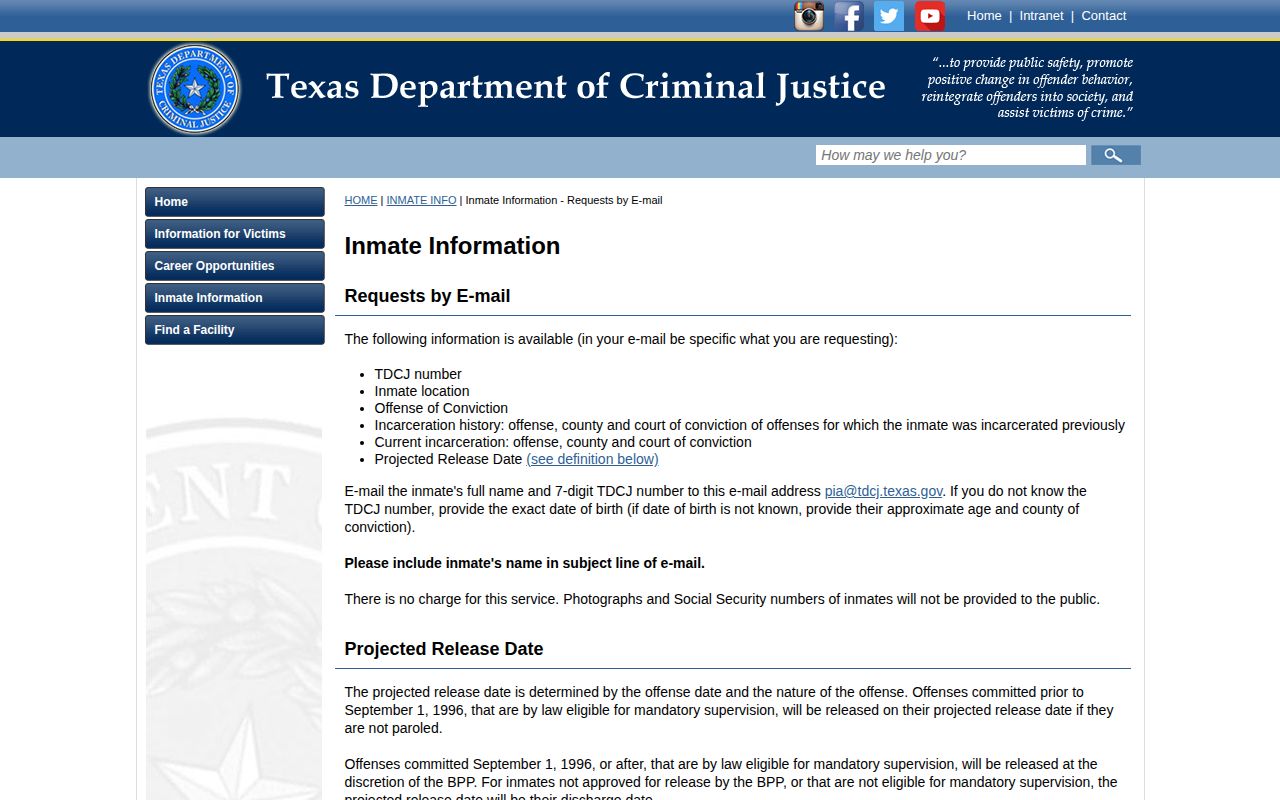
This route supports historical confirmation, where projected fields and a no-result screen cannot answer the question.
Include the TDCJ number whenever possible. A name-only result can collide with another person, while a county booking number does not belong in a state identifier field. If the person was released to parole or mandatory supervision, confirm the supervising office and distinguish that community status from discharge. If TDCJ reports a transfer, follow the new unit or agency rather than assuming community release.
TDCJ’s email route asks for a full name and seven-digit TDCJ number, or an exact date of birth. If birth date is unknown, approximate age and county of conviction can help identify the record. Ask specifically for the historical release or discharge field needed. Routine information and formal Public Information Act requests are different paths, so use the formal route if the quick service does not cover the record.
Childress Jail Release Date Records
Childress County publishes no routine release hour, weekend procedure, or promise that an order produces same-day departure. Call the jail at (940) 937-2535 before travel. Ask whether the order reached staff, whether another hold remains, where release occurs, and what identification is required. Bond-posting time is not the jail-door time.
A narrow written request should seek the booking sheet, custody-release log, actual date and time, release authority, and destination. Email sheriff@childresstx.us or write to 1005 Avenue F NW, Childress, TX 79201. Ask for electronic copies and an itemized estimate. Texas Government Code Chapter 552 requires existing records, but not a new forecast.
Compare the movement entry with the cause record. The court tells what was ordered. The jail tells when custody ended and whether it ended in the community or at another agency.
If the record shows a receiving agency, follow that path. TDCJ intake, another county, the U.S. Marshals Service, and ICE each use different locators and records contacts. “Out” of Childress custody may therefore mark a handoff. Ask for the public receiving-agency name and the release type or authority, not a private destination address.
The county jail has not published an online retention period for release entries. Website display length and official record retention are different. A missing old entry should lead to a written request, not a conclusion that the release never occurred. Include a narrow date range and ask for records in their existing form so staff can locate the booking without creating an analysis.
Confirm Childress Actual Release Dates
Notifications are useful prompts, not final records. County IVSS can alert on a Childress booking or custody change when the event is available. TDCJ has a separate IVSS for state custody and supervision. Register with the system matching the custodian.
When an alert arrives, save its exact wording and time, then confirm with the sheriff or TDCJ. Pair a county release entry with the bond, dismissal, judgment, or sentence order. Pair a TDCJ parole release with the board or parole record. The Childress VINELink Release Check explains both paths.
Actual release, parole, mandatory supervision, and discharge remain distinct. A parolee is outside prison but still supervised. If records disagree, ask about the data date and obtain the movement record instead of choosing the result that looks newest.
Save a two-source packet. For a county community release, use the sheriff entry plus the bond, dismissal, or judgment order. For a state parole release, use TDCJ actual status plus the parole decision. For a completed sentence, use incarceration history or discharge information plus the judgment. These pairings show both physical custody and legal authority.
For each lookup, note the agency, query time, exact status phrase, and “information as of” date. Keep a screenshot only when it preserves those labels without exposing details that are not needed. A forecast may change after the capture, so return to the official system before relying on it for travel or a planned pickup.
Call one office with one clear question at a time. Ask whether Childress custody ended by community release or transfer, what actual date and time were recorded, and which agency received custody if there was a handoff. For TDCJ, ask whether the date is projected, parole eligibility, actual release, or discharge. Follow an important call with a written request so the answer can be tied to a stable record.
No official Childress source supplied a routine jail release time, a local release-date calculator, or a recent county release statistic. Those are bounded negative findings, not blanks to fill with an estimate. The record custodian and the governing court remain the reliable route for a specific person.
Public Record Search
Sponsored Results